%20(2).png)
Is Life Insurance Cash Value Taxable? Here’s the Real Answer
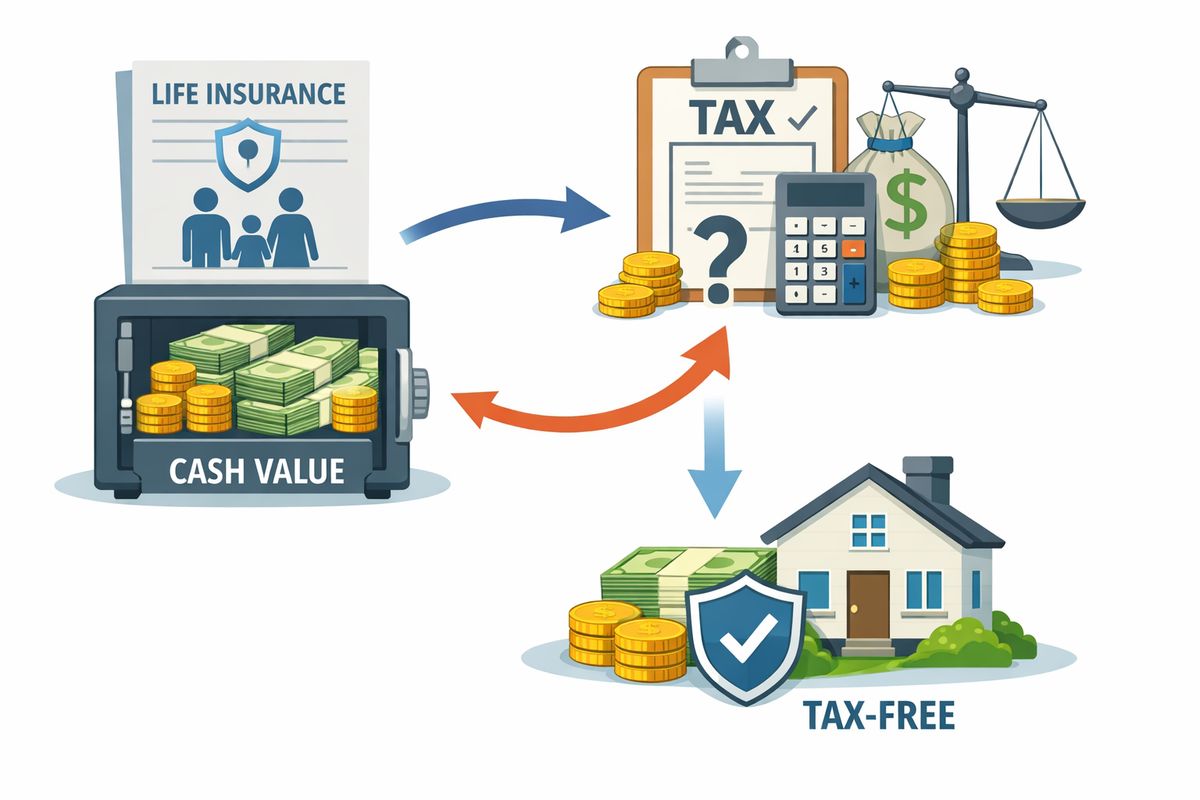
Cash value in a life insurance policy is not usually taxable while it stays inside the policy, but that does not mean every dollar you access stays tax-free. If you have ever looked at a policy statement at the kitchen table and wondered which numbers are safe and which ones could wake up the IRS, this is the real answer.
What “cash value” means in life insurance
Cash value is the savings-like portion that builds inside a permanent life insurance policy. You usually see it in whole life, universal life, variable universal life, and similar policies. You do not see it in term life insurance, because term coverage is built to provide a death benefit for a set period, not to accumulate value.
That distinction matters. If your policy is term life, the question of cash value taxation mostly ends there because no cash value exists to tax. If your policy is permanent, part of your premium supports insurance costs and part may build into cash value over time.
Think of cash value as money growing inside the policy wrapper. You do not hold it in a separate bank account, but you may be able to borrow against it, withdraw from it, use it to help pay premiums, or receive it if you surrender the policy.
Is life insurance cash value taxable? the real short answer
The short answer to “is life insurance cash value taxable” is no, not while the growth remains inside the policy. Taxes usually show up when you take money out, cancel the policy for cash, sell the policy, or let a policy loan contribute to a lapse.
That simple split helps: what happens inside the policy is usually treated differently from money that leaves the policy. Much of the confusion comes from mixing those two situations together.
The basic rule you can use
Use this rule: cash value growth is generally tax-deferred, and taxes usually depend on whether you receive more than your cost basis. Your cost basis is generally the amount you paid in premiums, reduced by certain prior untaxed distributions.
If your policy stays in force and the value keeps building, no current income tax usually applies to that growth. Once you start pulling money out, the tax analysis changes.
When cash value is not taxable
Several common situations are often described as tax-free, but the better phrase is not taxable right now. That wording is less comforting, but it is more accurate.
Growth inside the policy
Cash value typically grows on a tax-deferred basis. That means you generally do not pay income tax each year on the increase while the money remains in the policy.
A simple way to picture it is bread dough rising on the counter. You do not measure and tax every bit of expansion while it sits there. You deal with the result when you take action. If you want a deeper look at that background growth, this explanation of money building inside the policy over time breaks down the mechanics.
Policy loans
Policy loans are generally not taxable when you take them. The reason is straightforward: you are borrowing against the policy’s value rather than pulling out taxable gain in the usual sense.
The catch is that the loan does not disappear. Interest accrues, and an unpaid loan reduces what remains in the policy. If the policy later lapses or is surrendered, that once-harmless loan can become part of a taxable event.
Death benefit paid to beneficiaries
The death benefit from life insurance is usually not subject to federal income tax when paid to beneficiaries in a lump sum. That rule is separate from cash value taxation, but the two are often confused.
Cash value belongs to the policy while you are alive. The death benefit is the amount paid after death. In most cases, that payout stays income-tax-free, which is why the usual tax treatment of a life insurance payout is discussed separately from cash value access rules.
When cash value can become taxable
This is the section that matters most if you are thinking about taking money from the policy.
Withdrawals above your cost basis
For many non-MEC permanent policies, withdrawals are taxed under a first-in, first-out approach. In plain English, your premium dollars generally come out first, and those dollars are usually not taxable because you already paid them with after-tax money.
Once you withdraw more than your cost basis, the excess can become taxable as ordinary income. If you paid $30,000 in premiums over time and withdraw $28,000, tax may not apply yet. If you later withdraw another $5,000, the amount above your remaining basis may be taxable.
Surrendering the policy for cash
If you surrender the policy, you cancel it and take the cash surrender value. Any amount you receive above what you paid in, after adjustments, is typically taxable as ordinary income.
Here is a concrete example. If you paid $18,000 into the policy over the years and receive $25,000 when you surrender it, the $7,000 gain is generally taxable. This is one of the clearest cases where cash value creates a tax bill.
That is also why broad claims about using life insurance for tax advantages need context. The tax treatment can be favorable, but only if you understand how money comes out.
If a policy loan causes a lapse
This is one of the most expensive surprises in permanent life insurance. A policy loan may feel tax-free for years because no immediate income tax is due when you borrow. But if the policy lapses with a loan outstanding, the IRS can treat the unpaid borrowed amount, to the extent it exceeds basis, as taxable income.
You may owe tax even if no cash lands in your bank account at that moment. That is what makes loan-driven lapses so painful. The statement may look manageable until performance drops, premiums stop, or interest builds faster than expected.
If your policy is a MEC
A Modified Endowment Contract, or MEC, is a life insurance policy funded beyond IRS limits for favorable access rules. Once a policy becomes a MEC, withdrawals and loans are usually taxed less favorably.
Instead of getting basis out first, gains often come out first. That means taxable income can show up sooner. If you are under age 59½, an additional tax penalty may also apply. Before treating a permanent policy as a source of tax-smart supplemental income later in life, you need to know whether MEC status applies.
Other tax situations you should not mix up with cash value
Cash value taxation is only one part of the life insurance tax picture. Several nearby issues sound similar but follow different rules.
Interest paid on death benefit installments
If an insurer holds the death benefit and pays it out over time, the death benefit itself is usually not taxable. Any interest earned on that held amount is generally taxable as income.
The line is simple: principal usually remains tax-free, interest usually does not.
Accelerated death benefits and living benefits
Some policies let you access part of the death benefit early because of a qualifying chronic, terminal, or sometimes critical illness. Those accelerated benefits are often not taxable, depending on the circumstances and policy design.
The exact rule depends on how the benefit is structured and why it is being paid. Still, this issue is about early death benefit access, not ordinary cash value withdrawals.
Employer-provided life insurance
Workplace group life insurance follows separate tax rules. Coverage above certain thresholds can create taxable imputed income, even if you never touch any policy value.
That issue is different from a personal permanent policy with cash value. If you want the broader map of what life insurance payments and proceeds are taxed and what are not, keep those categories separate.
Common questions about cash value and taxes
A few questions come up again and again because policy statements use similar words for very different tax results.
Do you get a 1099 when you cash out a life insurance policy?
Yes, you may receive a tax form if part of a surrender, withdrawal, or other distribution is taxable. The form reports the taxable portion so you can include it on your return.
No 1099 does not automatically mean no tax issue exists. But if taxable gain is recognized, a reporting form is common.
Can the IRS go after life insurance cash value?
Cash value can be treated as an asset in certain tax collection or legal situations. Tax deferral does not make it invisible.
That does not change the usual rule on current taxation while the policy remains active. It simply means the value can still matter in disputes involving assets, debts, or collection.
Is cash value considered an asset?
Yes, cash value is generally an asset you own within the policy. That matters for financial planning, policy loans, estate issues, and some state-specific creditor or bankruptcy rules.
The insurance policy is not just coverage. In a permanent policy, it also holds an economic value that belongs to you.
Can you use cash value to pay premiums without triggering taxes?
Using cash value to cover premiums does not automatically create a tax bill. But repeated withdrawals, policy changes, and poor performance can reduce basis, shrink the cushion supporting the policy, and raise lapse risk later.
In other words, paying premiums from cash value can work, but it is not a free move. It changes the policy.
How to check whether your policy could create a tax bill
A tax issue usually appears because a policy owner looks only at available cash and not at the tax character of that cash. The fix is usually simple.
Find your cost basis
Start with total premiums paid into the policy. Then account for prior withdrawals, dividends used in certain ways, or other untaxed distributions if applicable. That number is your anchor.
Without cost basis, you cannot tell where tax-free return of premium ends and taxable gain begins.
Review loans, withdrawals, and MEC status
These three items decide many real-world tax outcomes. Review your annual statement for outstanding loan balances, past distributions, and any indication that the policy is a MEC.
If the statement is unclear, ask the insurer for confirmation of basis, loan balance, and surrender value after charges. One accurate policy summary can prevent a costly mistake.
Try this before you take money out
Request an in-force illustration or policy values report before taking a withdrawal, loan, or surrender. That document can show how the policy may perform after the transaction and whether lapse risk increases.
One phone call on a Tuesday afternoon can spare you a tax bill that arrives months later. Try that before you touch the cash value.
Frequently asked questions
Is cash value taxed every year as it grows?
No. In most permanent life insurance policies, growth is tax-deferred while it stays inside the policy. Tax usually appears only when money comes out or the policy ends in a taxable way.
Are life insurance premiums tax-deductible?
Usually not for personal life insurance. Premiums are generally paid with after-tax dollars, which is part of why your cost basis matters later.
Is a policy loan better than a withdrawal for taxes?
A loan is often more tax-friendly at the time you take it because it is generally not treated as taxable income right away. But an unmanaged loan can create a tax problem later if the policy lapses or is surrendered.
What happens if you sell your life insurance policy?
Selling a policy can trigger tax consequences that differ from a normal surrender. Part of the proceeds may be taxable, and the exact treatment can be more complex than a standard withdrawal.
Does term life insurance have cash value to tax?
No. Term life insurance generally does not build cash value, so this issue usually applies only to permanent life insurance.
What changes once you understand the rule?
Once you separate growth inside the policy from money taken out, most of the confusion disappears. The practical rule is simple: know your basis, watch your loans, confirm MEC status, and check the numbers before making a move.
Insurance insights and tips




%20(3).png)