%20(2).png)
Life Insurance and Income Tax: What’s Taxed, What Isn’t
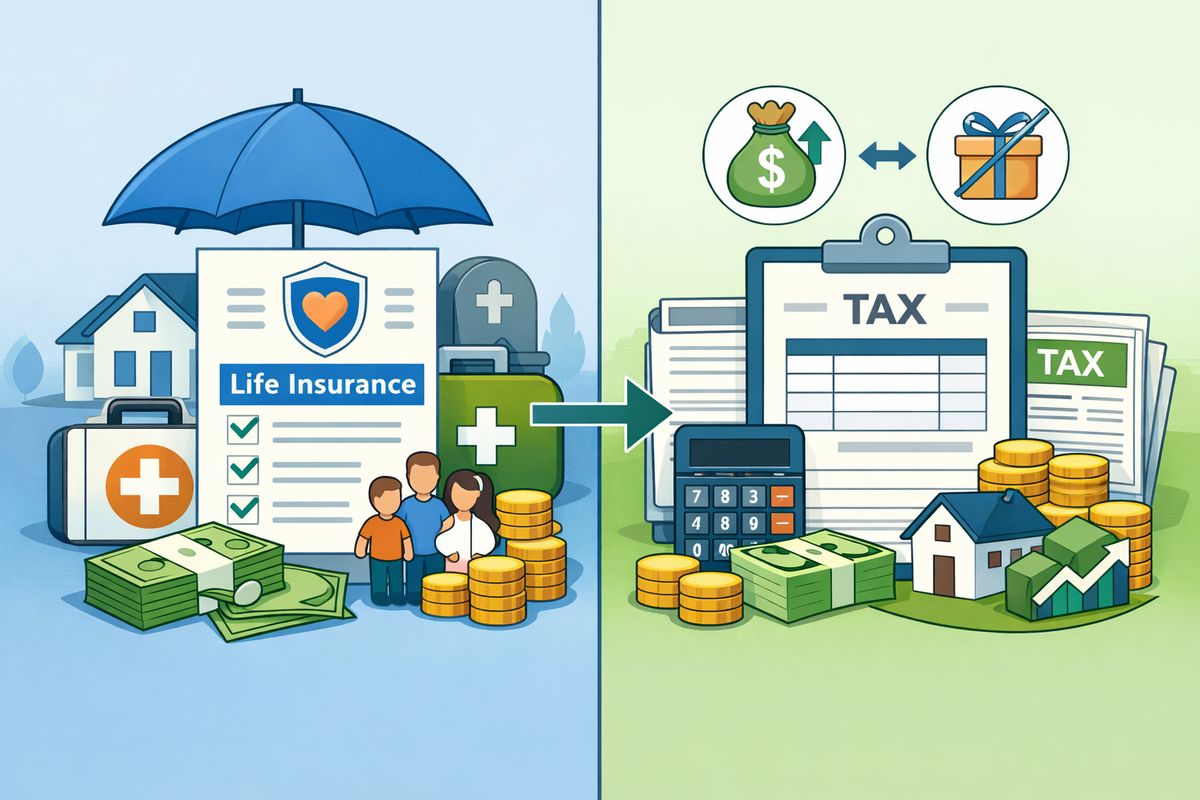
Life insurance and income tax sounds simple until the money is real and the questions get urgent. Here’s the rule that clears most of the fog: a standard life insurance death benefit paid in one lump sum is generally not subject to federal income tax, but interest, cash-value transactions, employer-paid coverage, and policy sales can create taxable income.
What you’ll learn in this guide:
- What usually stays income-tax free
- What triggers taxable income
- How term, permanent, and MEC policies differ
- Where employer coverage creates tax issues
- How estate and inheritance tax fit in
- One smart move to make today
Life insurance and income tax basics
Life insurance and income tax get tangled because one product can do two jobs at once. It can pay a death benefit to your beneficiary, and with permanent insurance, it can also build cash value during your lifetime. One side is usually simple. The other side is where the tax questions start.
You also need to separate income tax from estate tax and inheritance tax. Income tax applies to taxable payments you receive. Estate tax applies to the value of property owned at death. Inheritance tax is a state-level tax charged in a small number of states when someone receives assets. Mix those together, and every answer sounds contradictory.
The core rule you need to know
The starting point is direct: if your beneficiary receives your life insurance death benefit in one lump sum, that payment is generally income-tax free. That is the default rule for most personal policies, and it answers the biggest question right away.
If you want the short version of why this usually works that way, start with why the death benefit usually passes without federal income tax.
Why life insurance tax questions get confusing fast
The confusion comes from all the side roads. Permanent policies have cash value. Delayed payouts can earn interest. Policy loans can turn ugly after a lapse. Employer-paid coverage creates taxable value on a W-2. Selling a policy creates a separate tax event.
Here’s the thing: none of those side issues erase the core rule. They sit around it. Once you keep that straight, the rest gets much easier to sort.
What is not taxed in most life insurance situations
Most life insurance tax treatment is actually favorable. That is one reason life insurance shows up in so many long-term planning conversations.
Lump-sum death benefits
A lump-sum death benefit paid to your named beneficiary is generally not taxable as income. It does not matter if the beneficiary is your spouse, your adult child, your sibling, or a friend. If the insurer pays the benefit in one check, the amount itself usually stays outside federal income tax.
That rule covers the most common situation by far.
Accelerated death benefits and living benefits
Accelerated death benefits let you access part of your policy’s death benefit early if you meet qualifying conditions, usually a terminal illness or certain serious chronic conditions. In plain English, you get some of the policy money while you are still alive.
When those payments meet IRS rules, they are generally income-tax free. The details matter, but the broad treatment is favorable.
Policy dividends in many cases
Some participating permanent policies pay dividends. Those dividends are usually treated as a return of premium, which means your insurer is effectively giving back part of what you paid.
That return is generally not taxable unless total dividends and similar untaxed amounts exceed your cost basis, meaning the amount you paid into the policy. If you want a deeper look at the broader tax advantages built into certain policies, that topic connects directly to dividends, cash value, and death benefits.
When life insurance becomes taxable
This is where most people actually need help. The taxable parts of life insurance are not random. They follow a few clear patterns.
Interest earned on delayed payouts
If an insurer keeps the death benefit and pays it out over time, any interest earned on that balance is taxable income. The death benefit itself stays income-tax free. Only the interest gets taxed.
Picture a family in Dallas choosing monthly payments after a kitchen-table meeting with an adviser. The monthly check arrives, and part of it is original death benefit, part is interest. That interest portion is taxable.
Installment payments vs. lump sums
A lump sum is cleaner. Installment payouts split the payment into two pieces: principal and interest. The principal, meaning the original death benefit, is generally tax-free. The interest is taxable.
That payout choice changes the tax result. Not the policy itself, the payout method.
Cash value withdrawals
Cash value is the savings-like portion inside a permanent policy such as whole life or universal life. If you withdraw money from that value, the tax result depends on your basis, which is generally your premiums paid minus prior untaxed distributions.
Withdraw up to your basis, and that amount is generally not taxed. Withdraw more than your basis, and the excess is taxable income. If you need a more focused explanation, this breakdown of how cash value taxation actually works helps sort withdrawals, gains, and basis.
Surrendering a policy for cash
When you surrender a permanent policy, you cancel it and take the cash surrender value. If that amount exceeds what you paid in premiums, the gain is taxable as ordinary income.
This catches people off guard because the policy felt like a protected bucket for years. Then surrender turns the gain into a tax event immediately.
Policy loans that turn taxable after a lapse
Policy loans are usually not taxable when the policy stays in force. That is the attractive part. You borrow against the cash value without triggering immediate income tax.
The catch is a lapse. If the policy lapses or gets surrendered while a loan is outstanding, the unpaid loan balance can be treated as distributed to you. If that pushes the total above your basis, the excess becomes taxable income. This is one of the most expensive surprises in permanent life insurance.
Selling your life insurance policy
A life settlement means you sell your policy to a third party for cash. After the sale, the buyer becomes the policy owner and collects the death benefit later.
Part of the proceeds can be taxable. The tax treatment depends on what you received compared with your basis and how the gain is classified under the rules. This is not a simple cash-out. It is a sale with real tax consequences.
How different life insurance types affect taxes
The tax rules get easier once you know what kind of policy you actually have.
Term life insurance
Term life is usually the cleanest form of life insurance for tax purposes because it has no cash value. You pay premiums for coverage over a set period. If you die during that term, the death benefit usually passes income-tax free.
Your premiums are generally not deductible for a personal term policy. No cash value also means fewer moving parts and fewer tax traps.
Permanent life insurance: whole and universal life
Permanent life insurance includes whole life and universal life. These policies build cash value, which creates more tax questions but also more planning flexibility.
The key tax feature is tax-deferred growth. Gains inside the policy generally are not taxed year by year while the policy remains active. That matters if you are comparing long-term planning tools or trying to understand how deferred growth inside life insurance really works.
Modified endowment contracts (MECs)
A Modified Endowment Contract, or MEC, is a policy funded too aggressively under IRS limits. Same insurance wrapper, worse tax treatment on distributions.
Here’s the catch: withdrawals and loans from a MEC are taxed gain first instead of basis first, and an additional tax can apply before age 59½. A MEC is still life insurance, but it loses one of the friendlier tax features people expect.
Employer-provided life insurance and work coverage rules
Work coverage follows its own rules, and payroll usually hides the tax issue until year-end.
When employer-paid coverage counts as taxable income
Group term life insurance through work is generally tax-free to you up to $50,000 of coverage. Above that threshold, the cost of the excess coverage counts as taxable income under IRS tables.
You do not get a bill from the insurer. Instead, the value gets assigned through payroll rules.
What your w-2 may show
That taxable value often appears on your W-2 as imputed income, meaning income assigned to you for tax purposes even though you did not receive cash in hand. You may notice slightly higher withholding during the year or a year-end tax form that seems odd until you connect it to employer-paid coverage.
Other taxes that get mixed up with income tax
A lot of online confusion comes from mixing separate tax systems together.
Estate tax
Estate tax is not income tax. Life insurance proceeds can be included in your taxable estate if you owned the policy at death. That matters only for larger estates under federal rules or certain state rules, but when it matters, it matters a lot.
Ownership drives this issue. Beneficiary choice does not erase ownership-based estate inclusion.
Inheritance tax
Inheritance tax is a state tax charged to the person receiving assets in a small number of states. It is separate from federal income tax and separate from estate tax.
So yes, a life insurance payout can be income-tax free and still raise a state-level inheritance or estate question. Different tax. Different rulebook.
Smart ways to reduce tax problems with life insurance
Good planning here is not fancy. It is mostly about avoiding predictable mistakes.
Choose the right payout method
A lump-sum death benefit usually keeps taxes cleaner because it avoids taxable interest on delayed payouts. Installments can still make sense if steady income matters more than simplicity, but you should know exactly what trade you are making.
Track your cost basis
Keep records of premiums paid, dividends received, and prior withdrawals. Your basis decides how much of a withdrawal or surrender is taxable.
Without good records, you are guessing. Tax planning based on guessing is how people overpay.
Watch for MEC and lapse triggers
Overfunding a policy can create MEC status. Heavy borrowing can push a policy toward lapse. Both create tax trouble fast.
If you are using permanent insurance as part of broader tax-smart wealth building with life insurance, regular reviews are nonnegotiable. You need to know whether the policy is still healthy and whether the tax treatment you expected still applies.
Review beneficiary and ownership decisions
Beneficiary designations control who gets paid. Ownership affects estate inclusion and administrative control. That setup on file is not paperwork clutter. It drives what happens later.
Check it before a claim, not after.
Quick answers to common life insurance tax questions
Are life insurance premiums tax-deductible?
No, personal life insurance premiums are generally not tax-deductible. Limited business exceptions exist, but for personal coverage, the answer is no.
Do you pay income tax on life insurance payouts?
A standard lump-sum death benefit is generally not taxable as income. Interest on delayed payouts, certain cash-value gains, and some policy transactions can be taxable.
Is cash value life insurance tax-free?
No. Growth inside the policy is generally tax-deferred, which is different from fully tax-free. Withdrawals above basis, surrenders with gain, and lapse-related loan issues can create taxable income.
What one thing should you do next?
Pull out your policy and check whether it is term, permanent, or employer-provided. That one detail tells you which tax rules apply first, and it clears up most confusion in about two minutes.
Frequently asked questions
Does a beneficiary report life insurance money on a tax return?
A beneficiary generally does not report a lump-sum death benefit as taxable income. If the payout earns interest before or during distribution, the interest portion is reportable.
Are policy loans from life insurance taxable right away?
No, not while the policy stays active. If the policy lapses or gets surrendered with a loan outstanding, the loan balance can trigger taxable income.
Is whole life insurance more tax-friendly than term life?
Whole life offers tax-deferred cash value growth and access features that term life does not have. Term life is simpler, but permanent life offers more tax-related planning options along with more rules.
Can life insurance create estate tax even if it avoids income tax?
Yes. Income tax and estate tax are separate issues. If you own the policy at death, the proceeds can be included in your taxable estate.
Do dividends from a life insurance policy count as taxable income?
Usually no. Dividends are generally treated as a return of premium until total untaxed amounts exceed your basis.
Getting life insurance and income tax right starts with one simple rule: separate the tax-free death benefit from the taxable extras around it. Try one thing today, find your policy, identify the policy type, and check how the payout is set up. That single review will tell you more than an hour of guessing.
Insurance insights and tips




%20(3).png)