%20(2).png)
Life Insurance Tax Benefits: What You Can Actually Keep
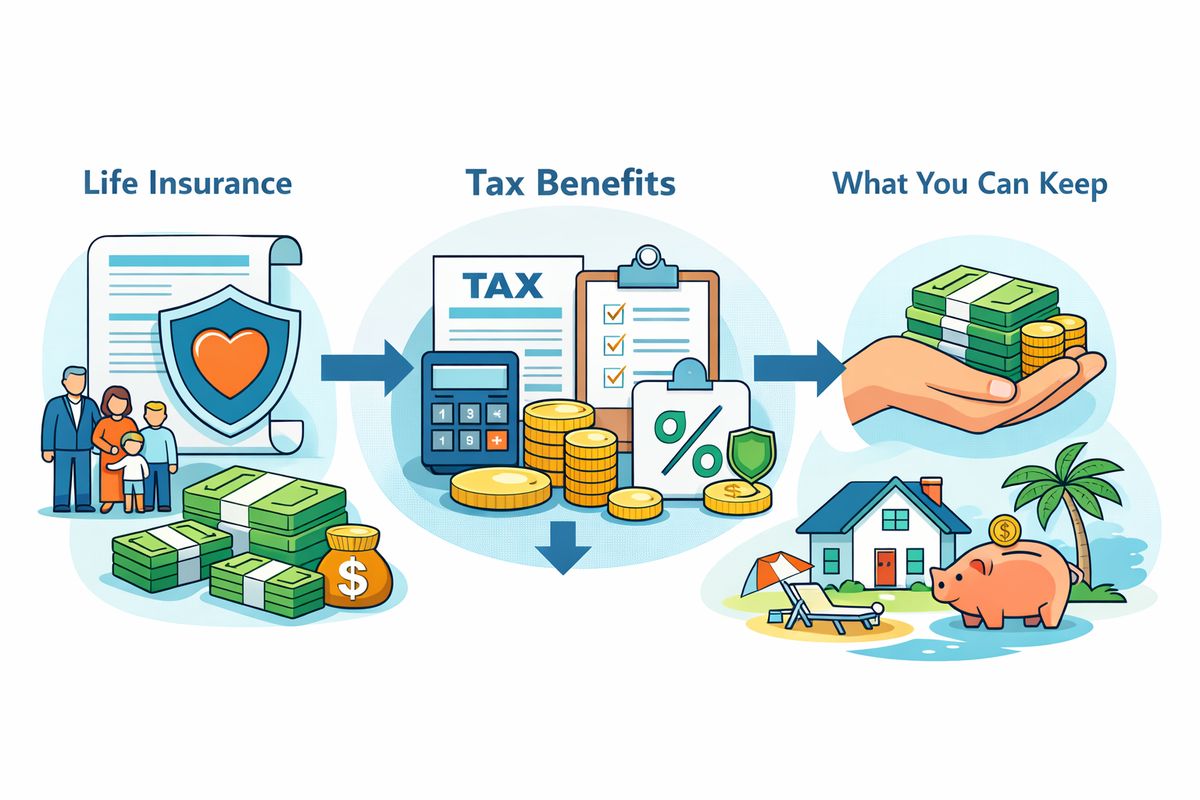
Life insurance tax benefits sound simple until you need to use them. The real question is not whether a policy has tax advantages, but how much of the money you actually keep when a benefit is paid, cash value is used, or a policy changes.
Life insurance tax benefits usually fall into three buckets: death benefits that are generally free from federal income tax, cash value growth that is not taxed each year inside the policy, and access to that cash value through loans or withdrawals that can receive favorable tax treatment. The catch is that those benefits follow rules, and certain loans, surrenders, payout choices, or funding mistakes can reduce what you keep.
What you will learn in this guide:
- Which life insurance payouts are usually tax free
- When cash value growth stays untaxed
- How loans and withdrawals are treated
- Where surprise tax bills come from
- How policy type changes the risk
- What to review before taking money out
What life insurance tax benefits actually mean for you
If your goal is simple, protect your family and keep more of the payout, life insurance can be unusually favorable under tax law. In the standard case, a beneficiary receives a lump-sum death benefit without federal income tax. That alone explains why life insurance remains such a common planning tool.
Permanent policies add another layer. If your policy builds cash value, that internal growth is generally tax deferred, meaning you do not report annual gains while the money stays inside the contract. You may also access cash value through withdrawals or policy loans, sometimes with little or no immediate tax cost.
Here is the part that matters most: favorable does not mean automatic. Once money starts moving out, the details matter. A surrendered policy, a large withdrawal, an unpaid loan, or a changed funding pattern can change the tax result quickly.
The three main tax benefits of life insurance
Death benefits are usually income tax free
This is the headline benefit. In most ordinary situations, your beneficiary receives the death benefit free from federal income tax, especially when the insurer pays it as a lump sum. For many households, that means mortgage payoff money, income replacement, or college funding arrives intact rather than reduced by income tax.
That treatment is the foundation of the policy's value. If you want a deeper look at why this rule exists and where it can change, see this explanation of why the final payout is usually protected from income tax.
Cash value can grow tax deferred
Cash value is the savings-like portion inside permanent life insurance, such as whole life or universal life. As that value grows, you generally do not owe tax each year on interest, dividends credited, or investment gains that remain inside the policy.
That tax deferral can matter over time. Money that is not reduced by annual taxation has more room to compound, much like leaving snow on a hill long enough for it to become a much larger pile. If you want the mechanics in more detail, review how growth inside a policy avoids annual taxation.
You can access cash value on a tax-advantaged basis
Accessing cash value is where many policies become more than pure protection. You can usually take money out in two ways: withdrawals and loans. A withdrawal removes part of the cash value directly. A loan uses the policy as collateral, and the insurer advances funds while the policy stays in force.
Loans are often not taxed when taken, which is why this feature gets so much attention. Still, favorable treatment depends on the policy remaining healthy and properly managed.
When life insurance proceeds can become taxable
Interest paid on death benefits is taxable
The death benefit itself is usually tax free, but interest earned after death is not. If proceeds stay with the insurer or are paid in installments, the original death benefit is usually excluded from income, while the extra earnings are taxable.
For example, if a $300,000 benefit remains on deposit and later grows to $312,000, that extra $12,000 is generally taxable interest. The principal is still treated differently from the earnings.
Surrenders and withdrawals can create taxable income
If you surrender a cash value policy, the tax calculation usually starts with your cost basis, which is generally the amount paid in premiums, adjusted for certain prior distributions. Amounts received above that basis can be taxable as ordinary income.
Withdrawals can work similarly, depending on policy structure and tax classification. If your total withdrawals stay within basis, tax may be avoided. Once distributions exceed basis, taxation often begins. This is why understanding when cash value becomes taxable matters before taking money out.
Policy loans can become taxable if the policy lapses
A policy loan is generally not taxable when borrowed. The problem appears later if the policy lapses or is surrendered with the loan still outstanding. In that case, the unpaid loan can be treated as if you received that amount, and taxable gain may be triggered even if little or no cash lands in your bank account.
This is one of the most expensive surprises in life insurance taxation. A heavily borrowed policy can look manageable on paper, then produce a tax bill after coverage collapses.
Accelerated death benefits are often tax free
Accelerated death benefits let you receive part of the death benefit early if you meet policy conditions, often involving terminal illness and sometimes qualifying chronic illness. These payments are frequently treated favorably for tax purposes.
Still, the exact result depends on the rider language and eligibility rules. It is wise to confirm tax treatment before electing the benefit.
How tax treatment differs by policy type
Term life insurance: simple tax treatment, few moving parts
Term life is usually the cleanest from a tax standpoint. There is no cash value in the standard policy, so the main tax feature is the generally income-tax-free death benefit. Premiums for personal term coverage are usually not deductible.
Whole life insurance: steady cash value and tax-deferred growth
Whole life builds cash value on a predictable schedule and may pay dividends, depending on the contract. Tax deferral applies while growth stays inside the policy. Loans can often be taken without immediate taxation, and withdrawals may be tax free up to basis.
Dividends are often treated as a return of premium rather than taxable income, at least until total dividends exceed basis. That treatment can change if dividends are handled in certain ways, so the details on your annual statement matter.
Universal life and variable universal life: more flexibility, more tax risk
Universal life and variable universal life follow the same broad tax framework, but with more moving parts. Cash value growth is still generally tax deferred, and loans can still be favorable. The difference is that flexible premiums, changing insurance charges, and in variable policies, market performance, can raise lapse risk.
That matters because tax problems often arrive through lapse rather than through the loan itself. If you are comparing advanced uses of permanent coverage for building wealth with better tax treatment, policy management matters as much as tax law.
Tax traps that can reduce what you keep
Modified endowment contract (MEC) rules
A modified endowment contract is a policy funded too quickly under tax rules. Once a policy becomes a MEC, loans and withdrawals can lose much of their favorable treatment. Distributions are typically taxed from gains first, and if you are under age 59½, penalties may also apply.
This rule catches people who aggressively overfund without checking limits first. A useful strategy can turn inefficient with one funding change.
Employer-provided life insurance can create taxable income
Group term life through work follows a different rule. If employer-provided coverage exceeds $50,000, the value of coverage above that amount can be treated as taxable income to you under IRS rules. That does not usually mean the death benefit becomes taxable. It means the cost of excess coverage may be added to your income while coverage is in force.
Selling a policy can trigger taxes
Selling a policy through a life settlement or viatical settlement creates a very different result from keeping the policy and naming a beneficiary. Depending on the sale amount and your basis, part of the proceeds may be taxable.
Estate taxes are a separate issue
Income tax and estate tax are not the same. A death benefit can be free from income tax but still count in your taxable estate in some situations. That issue is usually relevant only for larger estates, but it is separate from the basic life insurance and income tax rules.
Are life insurance premiums tax deductible?
Personal life insurance premiums are usually not deductible
For most personal policies, the answer is no. Premiums for coverage on your life, your spouse, or your family are generally paid with after-tax dollars.
Business-related exceptions have narrow rules
Some business situations receive different treatment, but the rules are narrow and highly fact specific. Employer-paid coverage, business-owned policies, and certain benefit arrangements can produce different results, though deductions are often limited.
How to keep more of the tax benefit
Track your cost basis and policy activity
Keep records of premiums paid, dividends used, prior withdrawals, and loan balances. Those numbers help determine whether a surrender or withdrawal may create taxable income.
Watch loan balances and lapse risk
Review annual statements and in-force illustrations, especially for older policies or policies with large loans. A statement opened at the kitchen table in April can reveal exactly what matters: shrinking cash value, rising loan interest, or warnings about lapse.
Avoid accidental MEC status when overfunding
Extra premium can improve cash value growth, but only within tax-rule limits. Before sending a large payment, confirm that the funding pattern will not push the policy into MEC status.
Get clarity before taking money out
Before choosing a loan, withdrawal, surrender, or installment payout, confirm how that move will be taxed. Start with one simple step: pull out your latest policy statement and check for cash value, any outstanding loan balance, and any warning about lapse or tax classification.
Frequently asked questions
Do beneficiaries pay taxes on life insurance proceeds?
Usually, no. A lump-sum death benefit is generally free from federal income tax. Interest earned after the insured's death can be taxable.
Are life insurance loans always tax free?
Not always. Loans are usually not taxed when taken, but if the policy lapses or is surrendered with an unpaid loan, taxable gain can be triggered.
Is cash value growth taxed every year?
Generally, no. In a permanent policy, cash value usually grows on a tax-deferred basis while it remains inside the contract.
Can you deduct life insurance premiums on your tax return?
In most personal situations, no. Personal life insurance premiums are usually not deductible.
What is the biggest tax mistake with permanent life insurance?
A common mistake is ignoring loan balances and lapse risk. Another is overfunding a policy into MEC status without understanding the tax consequences.
Insurance insights and tips




%20(3).png)