%20(2).png)
How Tax-Deferred Growth Works in Life Insurance
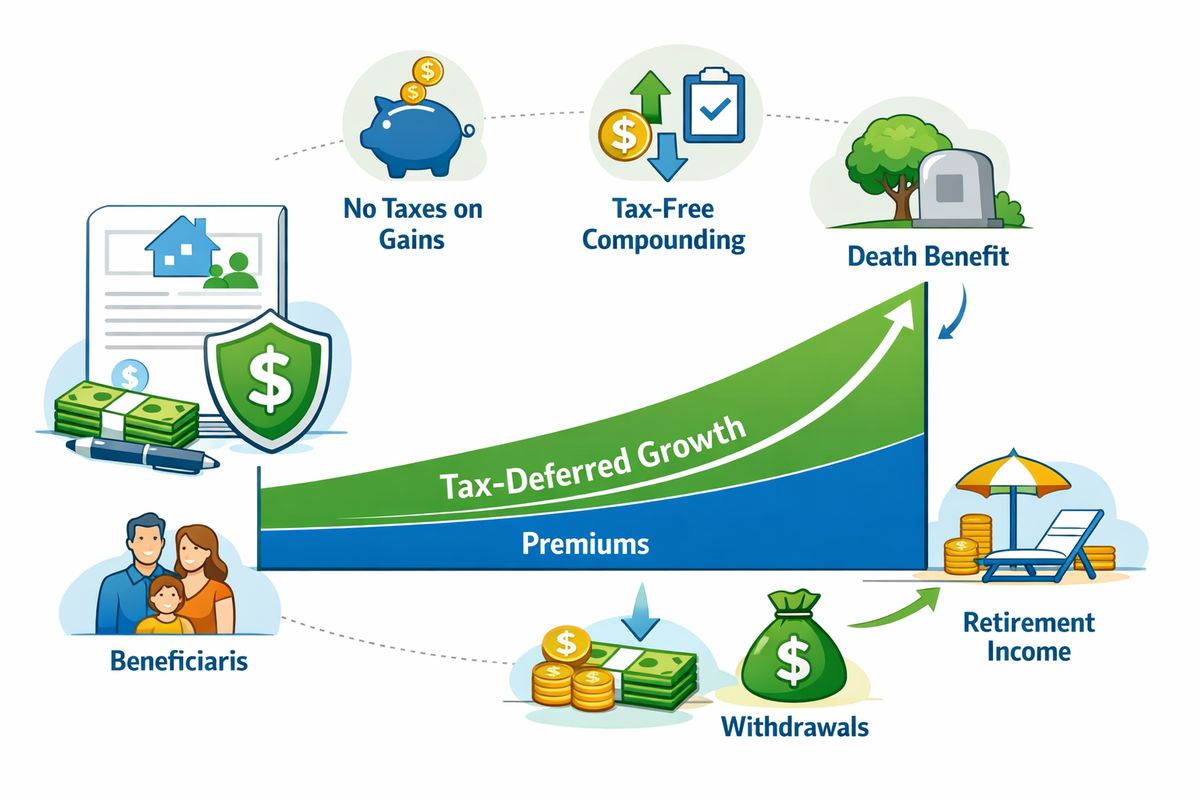
Tax-deferred growth life insurance is a way to build cash value inside a permanent life insurance policy without paying income tax on that growth each year. If you have ever watched investment gains get clipped by annual taxes, this is the part that gets your attention, because the money keeps compounding inside the policy while it stays there.
What tax-deferred growth means in life insurance
You want growth. The problem is that taxes can keep taking a bite out of it year after year. Tax-deferred growth life insurance solves that in a specific way: the cash value inside certain permanent life insurance policies grows without current income tax as long as the money stays in the policy.
That definition matters because not all life insurance works this way. Term life insurance is pure coverage for a set number of years. It has no cash value account tucked inside it, so there is nothing growing on a tax-deferred basis. This tax treatment belongs to cash value life insurance, meaning permanent policies that combine lifelong coverage with an internal value account.
Think of it like a thermos for money. The growth stays contained inside the policy instead of getting exposed to yearly income taxes along the way.
How tax-deferred growth actually works
A permanent life insurance policy takes your premium and splits it into different jobs. One part covers the cost of insurance and policy expenses. Another part builds cash value. That cash value then earns interest, credits, dividends, or investment returns depending on the policy type.
Here is the core point: you do not pay taxes each year on gains inside the policy while the money remains there. No annual tax bill for interest credited to the policy. No annual tax bill for internal gains. The value compounds inside the contract.
That does not mean every dollar you touch later is automatically tax-free. It means the growth is deferred, not taxed currently. That difference is where most confusion starts.
Where the growth happens
The growth happens in the policy’s cash value, which is the savings-like component inside permanent life insurance. Permanent life insurance means coverage designed to last for your lifetime as long as required premiums are paid or the policy is otherwise properly funded.
Common types include whole life, universal life, and variable universal life. Each one handles growth differently, but all share the same broad idea: part of your premium supports a cash value account that can grow over time.
If you want a wider view of how cash value gets taxed when money comes out, it helps to understand what counts as taxable cash value and what does not.
What “tax-deferred” does and does not mean
Tax-deferred means untaxed for now, not untaxed forever in every situation. As long as gains stay inside the policy, you generally do not report them as current income. That is the tax deferral.
Accessing money is where the rules change. Policy loans are often used because borrowed amounts are generally not treated as current taxable income. Withdrawals are different. You can usually withdraw up to your basis first, which means the amount you paid in premiums, without income tax. Take more than that, and the excess can become taxable.
Structure matters too. Loans, withdrawals, and the order you use them all affect the tax result.
Which life insurance policies offer tax-deferred growth
All three common permanent policy types offer tax-deferred growth, but the way they build cash value is not the same. Policy design changes the pace of growth, the cost structure, and how predictable the outcome feels.
That is why two policies with the same death benefit can produce very different long-term results.
Whole life insurance
Whole life insurance uses fixed premiums and offers guaranteed cash value growth under the policy terms. In participating policies, you can also receive dividends, which can increase cash value and death benefit if you leave them in the policy.
This is the version most people picture first because it is steady and easier to follow. You pay a set premium. The policy builds value on a predictable schedule. The tradeoff is cost, since whole life usually requires higher premiums than term coverage.
Universal life insurance
Universal life insurance adds flexibility. You can often adjust premiums and sometimes the death benefit within policy limits. Cash value growth usually comes from interest credited by the insurer, based on the policy’s terms.
That flexibility sounds great, and sometimes it is. The catch is that costs inside the policy can change, and low crediting rates can leave the policy underpowered if it is not funded properly. You need to pay attention to the illustration, not just the sales pitch.
Variable universal life insurance
Variable universal life insurance puts cash value into investment subaccounts tied to market performance. That gives you more growth potential, but also more risk and more moving parts.
In a strong market, growth can be far higher than in fixed policies. In a weak market, losses hit the cash value directly. This is not a set-it-and-forget-it product. It is part insurance contract, part investment engine.
The main tax benefits you get
The value of this strategy is simple: it combines insurance protection with tax treatment that can improve long-term compounding and create flexible access to cash.
That combination is the whole reason people look at it in the first place.
No annual tax bill on internal growth
Inside a taxable brokerage account, interest, dividends, and realized gains can create a tax bill along the way. Inside a cash value life insurance policy, internal growth generally keeps building without that yearly interruption.
Picture a snowball rolling downhill. In a taxable account, somebody stops it every season and chips off a piece. In a tax-deferred policy, the snowball keeps rolling. Over long periods, that difference matters.
If you want a broader breakdown of how these advantages fit together, this plain-English guide to the tax perks built into life insurance helps connect the dots.
Accessing cash through loans and withdrawals
Policy loans let you borrow against the cash value instead of pulling money out by selling an asset. That is why people often use life insurance for liquidity. The loan is secured by your policy, and interest applies, but the borrowed amount is generally not taxed as current income.
Withdrawals work differently. Your basis, meaning the premiums you paid into the policy, usually comes out first without income tax. Once you withdraw more than your basis, taxes can apply to the gain portion.
A lot of retirement planning around permanent insurance depends on this distinction. If you want to see how that fits into broader planning, using insurance alongside other tax-smart income approaches is the right next layer.
Death benefit treatment for beneficiaries
The death benefit is generally paid to beneficiaries income-tax-free. That matters because it creates immediate liquidity at exactly the moment families often need cash fast.
Imagine a house in Phoenix that needs to stay in the family, but expenses and taxes show up right after a death. A life insurance payout gives heirs cash without forcing a rushed sale. That is why permanent coverage often shows up in estate and family planning, not just personal protection. For more on that specific rule, this explanation of why payouts usually pass free of income tax covers the basics clearly.
The catch: rules, limits, and common tax traps
Tax-deferred growth is real. So are the traps. Ignore the rules and the tax story gets worse fast.
Modified endowment contract (MEC) rules
A Modified Endowment Contract, or MEC, is a life insurance policy funded too aggressively under IRS limits. Once a policy becomes a MEC, distributions lose some of the usual tax advantages.
That matters most if your goal is easy tax-efficient access to cash value. Loans and withdrawals from a MEC are taxed less favorably, often on a gain-first basis. If you are using life insurance for accumulation, MEC status is not a detail. It is a line you need to watch carefully.
Surrenders, lapses, and surprise taxes
If you surrender a policy for cash, any gain above your basis can be taxable. If the policy lapses, meaning it terminates because funding falls short, the tax result can be even uglier.
Loans make this worse. An outstanding loan reduces available value, but for tax purposes the gain can still become taxable if the policy collapses. That is how people end up shocked by a tax bill from a policy that no longer exists.
Premiums are usually not tax-deductible
Personal life insurance premiums are generally not tax-deductible. That answer is short because it is straightforward.
You get tax deferral on internal growth and favorable treatment in certain distributions and death benefits. You do not get to deduct the premiums in the usual personal planning context. If you want the bigger picture, this breakdown of what gets taxed and what does not in life insurance lays it out cleanly.
When tax-deferred growth in life insurance makes sense
This works best when you want both permanent coverage and tax treatment. If your only goal is cheap investing, life insurance is rarely the first tool to reach for.
But in the right situation, it fits.
Good fit situations
A strong fit starts when you have already maxed out major retirement accounts and still want another place for tax-advantaged accumulation. It also makes sense when you want permanent death benefit protection, predictable access to cash, or a clean way to leave money to heirs.
It is especially useful if liquidity matters. If your family would need cash quickly after a death, permanent life insurance creates a pool of money that arrives without forcing a scramble to sell property, liquidate investments at the wrong time, or fight over timing.
When another account is a better first move
If you do not need permanent coverage, start somewhere else. If your priority is the lowest-cost path to market investing, start somewhere else. If your budget only supports minimal premiums, start somewhere else.
Life insurance works best when protection and tax treatment both matter to you. Used for that purpose, it can be smart. Used as a substitute for every other account, it gets expensive fast.
Common questions about tax-deferred growth life insurance
Is term life insurance tax-deferred?
No. Term life insurance generally has no cash value, so nothing grows inside the policy on a tax-deferred basis.
Do you ever pay taxes on cash value growth?
Yes. Taxes can apply if you withdraw more than your basis, surrender the policy with gains, or let a policy lapse with outstanding loans.
Can you use life insurance as a retirement income source?
Yes, but only if the policy is designed and managed correctly. Many strategies use withdrawals up to basis and then policy loans, but bad funding or poor loan management can wreck the tax treatment.
Are policy loans always tax-free?
No. Policy loans are generally not treated as current taxable income while the policy stays in force, but a lapse or surrender can trigger taxes tied to gains and loan balances.
Is tax-deferred the same as tax-free?
No. Tax-deferred means you postpone tax while growth stays inside the policy. Tax-free applies more narrowly, such as the general income-tax treatment of death benefits and certain properly structured distributions.
What to check before you buy
Before you sign anything, look at the policy type, internal costs, cash value illustration, loan provisions, MEC limits, and long-term funding pattern. The details decide whether the tax advantages help you or turn into expensive disappointment.
Here is the simplest move to make: ask for an in-force illustration or policy illustration that shows cash value, loans, and taxes year by year before signing anything. If that projection is hard to get or hard to explain, walk away.
Insurance insights and tips




%20(3).png)